
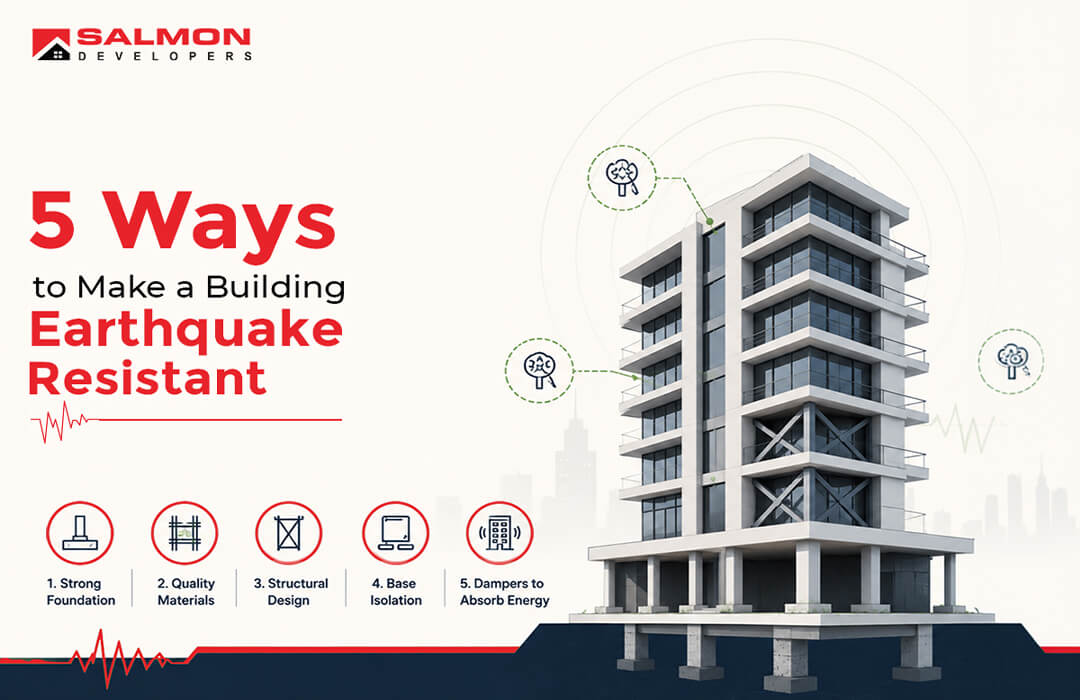
5 Ways to Make a Building Earthquake Resistant
When people evaluate a property, they usually focus on location, design, amenities, and price. Yet one of the most important factors influencing long-term safety often receives far less attention: building earthquake resistance.
Although Bangladesh does not experience major earthquakes frequently, experts have long warned about the country's seismic vulnerability. In densely populated cities such as Dhaka, rapid urban development, high-rise construction, and aging infrastructure make structural safety a critical concern for homeowners, developers, and investors alike.
The good news is that modern engineering has significantly improved the way buildings are designed to withstand earthquakes. While no structure can be completely earthquake proof, a properly engineered earthquake resistant building can reduce damage, protect occupants, and improve overall resilience during seismic events.
In this article, we'll explore five proven ways to improve building earthquake resistance, discuss common construction challenges in Bangladesh, and explain what property buyers should look for when evaluating a building's structural safety.
What Is an Earthquake Resistant Building?
An earthquake resistant building is designed to absorb and distribute seismic forces without experiencing catastrophic structural failure.
When an earthquake occurs, energy travels through the ground in the form of seismic waves. These waves create movement that places enormous stress on foundations, columns, beams, and walls. If a building lacks proper engineering, cracks, structural damage, or collapse can occur.
Modern earthquake resistant construction focuses on allowing controlled movement rather than attempting to eliminate movement entirely. A well-designed seismic resistant building can flex, absorb energy, and remain structurally stable during ground shaking.
Why Earthquake Resistance Matters in Bangladesh
Bangladesh lies within a region influenced by several active tectonic systems. Although major earthquakes are relatively uncommon, seismic experts continue to identify earthquake risk as a significant concern for urban areas.
Dhaka faces several unique challenges:
- High population density
- Rapid urban expansion
- Increasing numbers of high-rise buildings
- Development on filled land and former wetlands
- Aging buildings in older neighborhoods
For homeowners and property investors, earthquake safety is not simply an engineering issue, it is also an important long-term investment consideration.
1. Build a Strong and Flexible Foundation
Every earthquake resistant structure begins with a strong foundation.
Conduct Proper Soil Testing
Before construction starts, engineers perform geotechnical investigations to understand soil conditions and determine the most suitable foundation system.
These studies evaluate:
- Soil bearing capacity
- Settlement potential
- Groundwater conditions
- Seismic response characteristics
Why Soil Conditions Matter in Bangladesh
This is particularly important in Bangladesh because many expanding residential areas have been developed on reclaimed land, filled soil, former low-lying areas, and locations near natural water bodies.
During strong ground shaking, loose saturated soil can amplify seismic forces. In extreme cases, a phenomenon called liquefaction may occur, where the soil temporarily loses strength and behaves like a liquid.
Use Deep and Reinforced Foundations
Where soil conditions require additional support, engineers often use reinforced concrete pile foundations that transfer building loads to stronger soil layers deep below the surface.
These systems help reduce settlement and improve stability during seismic events.
Consider Base Isolation Systems
One of the most effective earthquake-resistant technologies is base isolation.
This system places flexible bearings between the building and its foundation, helping reduce the amount of seismic energy transferred into the structure.
Many modern earthquake resistant buildings around the world successfully use this approach.
2. Install Shear Walls and Cross Bracing
Earthquakes generate powerful horizontal forces that can cause buildings to sway from side to side.
What Are Shear Walls?
Shear walls are reinforced concrete walls specifically designed to resist lateral movement.
They help:
- Improve structural stability
- Reduce excessive sway
- Distribute seismic forces
- Prevent structural distortion
In many buildings, shear walls are strategically located around lift cores, stairwells, and service shafts.
Understanding the Soft-Story Parking Challenge
One common feature in many apartment buildings across Bangladesh is ground-floor parking.
While convenient, open parking levels supported primarily by columns can create what engineers call a soft-story condition.
In a soft-story building:
- Upper floors contain heavy walls and partitions
- The ground floor remains relatively open
- Earthquake forces become concentrated on lower-level columns
If not properly engineered, this design can increase structural vulnerability during an earthquake.
To address this challenge, structural engineers often use:
- Thicker reinforced ground-floor columns with additional steel confinement reinforcement
- Enhanced lateral load-resisting systems
- Strategically placed shear walls
- Improved structural detailing
Benefits of Cross Bracing
Steel cross-bracing systems further improve building earthquake resistance by helping distribute seismic forces throughout the structure.
Together, shear walls and cross bracing form a critical part of earthquake resistant design.
3. Follow Earthquake-Resistant Building Codes
Even the strongest materials cannot compensate for poor engineering.
Why Building Codes Matter
Building regulations are based on decades of engineering research, structural testing, and lessons learned from real earthquakes.
They provide guidance on:
- Structural design requirements
- Reinforcement detailing
- Material specifications
- Safety factors
- Load calculations
Importance of BNBC Compliance
In Bangladesh, engineers follow the Bangladesh National Building Code (BNBC), which includes seismic design provisions intended to improve building safety.
Bangladesh is divided into multiple seismic zones, with different regions requiring different levels of earthquake-resistant design. Areas with greater seismic risk require additional reinforcement, ductile detailing, and stronger lateral force-resisting systems.
Because seismic requirements vary by location, structural engineers must design buildings according to the applicable code provisions before obtaining project approvals.
Professional Structural Engineering Matters
Earthquake resistant construction relies heavily on proper structural analysis.
Qualified engineers evaluate:
- Foundation performance
- Seismic loads
- Structural behavior
- Reinforcement requirements
- Building geometry
These calculations help ensure that the building can safely withstand the forces generated during an earthquake.
4. Use High-Quality Construction Materials
Material quality plays a major role in determining how a building performs during an earthquake.
Reinforced Concrete and Structural Steel
Most modern earthquake resistant buildings rely on reinforced concrete and structural steel because they offer an effective balance of strength and flexibility.
Proper reinforcement allows structural elements to bend and absorb energy without breaking.
Flexible Construction Components
Buildings that can absorb movement generally perform better during earthquakes than structures that are overly rigid.
Engineers often select materials and connection systems that improve flexibility and energy dissipation.
Lightweight Non-Structural Elements
Heavy roofing systems and decorative architectural components can increase seismic risk.
Using lighter materials helps reduce building mass and lower earthquake-induced forces.
5. Incorporate Modern Earthquake Protection Technology
Advancements in engineering continue to improve earthquake safety in buildings.
Seismic Dampers
Seismic dampers function similarly to vehicle shock absorbers. They absorb earthquake energy and reduce structural vibration.
Shock Absorption Systems
Modern vibration-control technologies help minimize building movement during seismic events.
These systems are increasingly used in commercial towers, hospitals, and critical infrastructure projects.
Smart Structural Monitoring
Some modern buildings include sensors that continuously monitor structural performance.
These systems provide valuable information after earthquakes and help identify maintenance needs.
As earthquake resistant technology continues to evolve, these innovations are becoming more common in major construction projects worldwide.
From Soil Investigation to Earthquake-Resistant Construction
Understanding the construction process can help property owners appreciate how earthquake resistance is built into a structure.
Phase 1: Geotechnical Investigation
Engineers conduct borehole testing and soil analysis to evaluate soil strength, groundwater conditions, settlement risks, and potential seismic behavior.
Phase 2: Foundation Design
Based on the soil report, engineers select appropriate foundation systems such as raft foundations or reinforced concrete piles that transfer loads to stable soil layers.
Phase 3: Structural Framing
Columns, beams, and slabs are constructed using properly reinforced concrete and structural steel designed to withstand seismic forces.
Phase 4: Shear Wall Integration
Reinforced concrete shear walls are strategically incorporated around lift cores, stairwells, and structural centers to improve resistance against lateral earthquake forces.
Phase 5: Quality Control and Inspection
Material testing, engineering supervision, and construction inspections help ensure that the completed structure performs as intended.
What Can Bangladesh Learn from Japan?
Japan is widely recognized as one of the world's leaders in earthquake resistant construction.
Japanese engineers commonly use:
- Base isolation systems
- Seismic dampers
- Flexible structural frames
- Advanced monitoring technologies
Rather than attempting to prevent movement completely, they focus on controlling and managing it safely.
This approach has helped many buildings withstand major earthquakes while minimizing structural damage.
Earthquake Safety Considerations for Property Buyers
Whether you're purchasing a home, apartment, or investment property, earthquake safety should be part of your evaluation process.
Ask About Soil Testing
Request information regarding geotechnical investigations and foundation design.
Verify Structural Design Standards
Ask whether the project follows current engineering standards and approved building regulations.
Review Developer Reputation
Experienced developers often place greater emphasis on quality control, engineering oversight, and regulatory compliance.
As a land-share real estate company in Bangladesh, Salmon Developers recognizes the importance of proper soil investigation, qualified structural engineering, and compliance with applicable construction standards when planning residential developments.
Verify Approvals and Professional Oversight
Property buyers should verify that projects have received the necessary approvals and that structural designs have been prepared and reviewed by qualified professionals.
Expert Tips
- Conduct soil testing before starting construction.
- Hire qualified structural engineers from the earliest planning stages.
- Follow applicable building codes and engineering standards.
- Use tested, high-quality construction materials.
- Incorporate shear walls and lateral force-resisting systems where appropriate.
- Schedule regular structural inspections.
- Address visible cracks and structural concerns promptly.
- Prioritize long-term safety over short-term cost savings.
Common Mistakes That Reduce Earthquake Resistance
Skipping Soil Investigations
Without proper soil analysis, foundation design may be inadequate for site conditions.
Using Poor-Quality Materials
Substandard concrete and steel can significantly weaken structural performance.
Ignoring Engineering Recommendations
Cost-cutting decisions often compromise building safety.
Unauthorized Structural Modifications
Removing walls or altering structural components without professional guidance can reduce building stability.
Prioritizing Appearance Over Structural Integrity
A visually attractive building should never come at the expense of engineering quality.
Conclusion
Creating an earthquake resistant building requires far more than simply using stronger materials. Effective earthquake resistant construction combines proper soil investigation, engineered foundations, structural reinforcement, quality materials, code-compliant design, and modern seismic technologies.
For homeowners, developers, and property buyers in Bangladesh, understanding these principles can lead to safer investments and more resilient buildings. While no structure can be completely earthquake proof, prioritizing earthquake resistant design remains one of the most effective ways to protect lives, property, and long-term value.
Table of Contents
- What Is an Earthquake Resistant Building?
- Why Earthquake Resistance Matters in Bangladesh
- 1. Build a Strong and Flexible Foundation
- 2. Install Shear Walls and Cross Bracing
- What Are Shear Walls?
- 3. Follow Earthquake-Resistant Building Codes
- 4. Use High-Quality Construction Materials
- Reinforced Concrete and Structural Steel
- Flexible Construction Components
- Lightweight Non-Structural Elements
- 5. Incorporate Modern Earthquake Protection Technology
- From Soil Investigation to Earthquake-Resistant Construction
- Phase 1: Geotechnical Investigation
- Phase 2: Foundation Design
- Phase 3: Structural Framing
- Phase 4: Shear Wall Integration
- Phase 5: Quality Control and Inspection
- What Can Bangladesh Learn from Japan?
- Earthquake Safety Considerations for Property Buyers
- Ask About Soil Testing
- Verify Structural Design Standards
- Review Developer Reputation
- Verify Approvals and Professional Oversight
- Expert Tips
- Common Mistakes That Reduce Earthquake Resistance
- Skipping Soil Investigations
- Using Poor-Quality Materials
- Ignoring Engineering Recommendations
- Unauthorized Structural Modifications
- Prioritizing Appearance Over Structural Integrity
- Conclusion


